How to Modernise Legacy Infrastructure Without a Greenfield Budget
The narrative around India’s data centre market focuses predominantly on new capacity: hyperscaler campuses, greenfield colocation facilities, edge deployments. This is understandable, new builds generate announcements, attract investment, and produce the headline MW figures that analysts track.
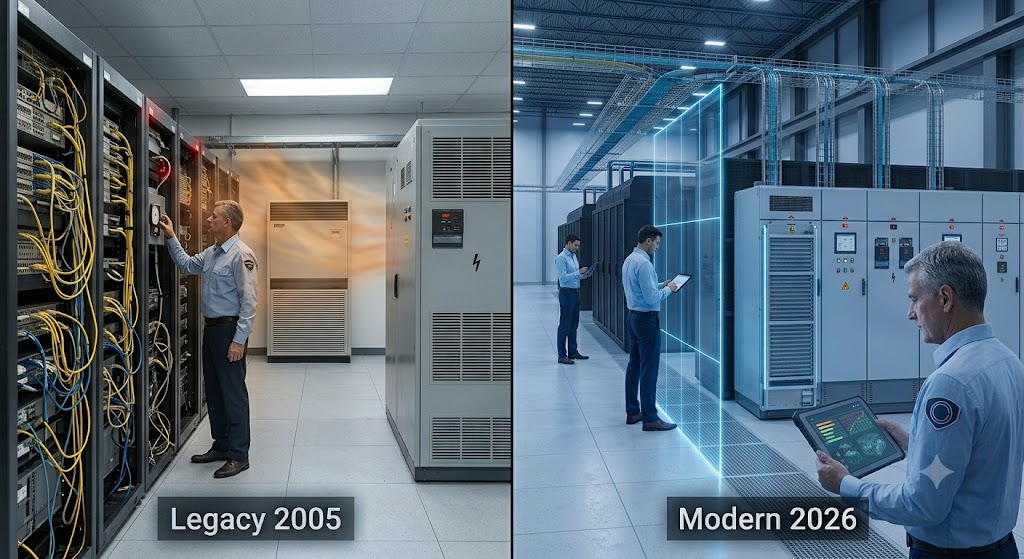
But the operational reality for most Indian enterprises is different. The majority of captive data centres in India were commissioned between 2005 and 2015. They were designed for workloads, densities and compliance environments that are substantially different from what their operators face today. They are being asked to support cloud-hybrid architectures, support higher-density compute (including AI inference workloads), and comply with regulatory frameworks – RBI, DPDP, PCI-DSS, that either did not exist when they were built or have been substantially revised since.
These organisations face a practical question: how do you modernise a data centre that is still in operation, cannot be taken offline, and does not have a greenfield budget? This article addresses that question directly.
The default position for many operators of legacy Indian data centres is to defer. Upgrades are capital-intensive. Downtime risk during construction is real. The business case for modernisation must compete with other IT investment priorities.
But deferral has costs of its own, and they compound over time:
Rising PUE and Energy Cost
Older data centres are significantly less energy-efficient than modern facilities. Power Usage Effectiveness (PUE) values of 2.0 to 2.5 are common in legacy Indian data centres, meaning that for every watt consumed by IT equipment, an additional 1.0 to 1.5 watts is consumed by cooling, power conditioning and other facility infrastructure. Modern facilities target PUE of 1.4 or below. At current electricity tariffs in India, the difference in energy cost between a PUE 2.2 and a PUE 1.5 facility for a 500 kW IT load is substantial, running to crore per annum over a multi-year horizon.
Stranded Capacity
Legacy data centres frequently have capacity that cannot be used because the cooling infrastructure cannot support the heat load of modern high-density equipment. White space exists on the floor plan, but deploying additional racks would create hotspots that the cooling system cannot manage. The result is stranded capacity, owned floor space that generates no productive output.
Compliance Exposure
Regulatory frameworks that govern data centre infrastructure in India have evolved significantly since most legacy facilities were commissioned. RBI’s IT governance requirements, DPDP Act infrastructure obligations, PCI-DSS 4.0 physical security requirements, and ISO 27001 controls all impose requirements that a facility built in 2008 may not meet. An unplanned regulatory inspection or a customer compliance audit can turn a deferred upgrade into an emergency remediation.
Vendor End-of-Life
The critical infrastructure equipment in a 10–15 year old data centre – UPS systems, precision cooling units, fire suppression panels, structured cabling, is approaching or has passed the manufacturer’s end-of-life date. End-of-life equipment means no manufacturer support, no spare parts, increased failure probability and, in some cases, insurance implications for a facility that relies on unsupported critical systems.
Not every legacy data centre should be upgraded. Some are sufficiently constrained by building structure, by available power, by location that a greenfield investment delivers better long-term value. Making the right decision requires a structured assessment, not an assumption.
| Decision Factor | Favour Brownfield Upgrade | Favour Greenfield |
| Building structure | Adequate floor loading (min 10 kN/m2), sufficient ceiling height, roof capable of supporting mechanical plant | Structural constraints that cannot be economically addressed |
| Power availability | Existing HT connection with headroom for expansion, or upgrade pathway confirmed with DISCOM | Power constraints at site that require new substation at cost comparable to greenfield |
| Location | Strategically located (low latency to users, connectivity hub access, within regulated geography) | Location constraints (flood risk, seismic exposure, connectivity limitations) that are not addressable |
| Operational continuity | Phased upgrade can be designed to maintain operations throughout -migration and cutover managed in stages | Facility is so constrained that no upgrade can be performed without full outage |
| Capex comparison | Upgrade capex plus operational savings from efficiency improvement compare favourably to greenfield on NPV | Greenfield NPV superior when site constraints require investment comparable to new build |
1. Power Infrastructure Upgrade
The most common brownfield intervention. Typical scope includes replacement of ageing UPS systems with modern lithium-ion or VRLA systems at higher efficiency ratings, upgrading switchgear and PDUs to support higher rack densities, adding or reconfiguring static transfer switches, and in some cases upgrading the HT connection and transformer infrastructure to accommodate expanded IT load. Power upgrades can typically be phased by zone, maintaining live capacity in unaffected areas during construction.
2. Cooling System Modernisation
Legacy precision cooling units are replaced with modern, higher-efficiency CRAC or CRAH units, and the cooling architecture is redesigned to support containment. Hot-aisle containment (or cold-aisle containment where ceiling height permits) dramatically improves cooling efficiency and enables CFD-validated PUE improvement. In some cases, the transition from direct expansion cooling to chilled water cooling is evaluated as part of the upgrade, particularly where capacity expansion is planned.
3. Structured Cabling and ELV Renewal
Legacy copper structured cabling that no longer supports the bandwidth requirements of modern workloads is replaced with modern fibre and copper infrastructure. ELV systems – fire suppression, access control, CCTV, DCIM are upgraded or replaced. These upgrades are often logistically complex in live environments, requiring careful planning of cutover sequences to avoid service disruption.
4. Fire Suppression System Upgrade
Older Halon or FM-200 fire suppression systems may require replacement due to regulatory changes, equipment end-of-life, or the need to support higher rack densities and altered room layouts. Modern clean agent systems (Novec 1230 or similar) or hybrid inert gas systems are specified based on the facility’s configuration and the relevant fire code requirements.
5. Compliance and Certification Remediation
Facilities that have identified compliance gaps, through an internal audit, a customer requirement, or a regulatory inspection, require targeted remediation against the specific non-conformances identified. Technavious’s approach to compliance remediation begins with a formal gap assessment against the applicable standards (TIA 942C, ISO 27001, PCI-DSS, RBI framework), produces a prioritised remediation plan, and delivers the remediation works with integrated certification audit to confirm compliance.
Brownfield upgrades in live data centre environments require a delivery methodology that is fundamentally different from greenfield construction. The constraints are different: existing equipment must remain operational, downtime windows are narrow and commercially sensitive, and the as-built condition of the existing facility often contains surprises that a desktop assessment would not reveal.
Technavious’s brownfield methodology follows four stages:
• Audit first: a comprehensive physical audit of the existing facility establishes the actual as-built condition, identifies deficiencies and constraints, and produces the evidence base for the upgrade design. This audit is not a desktop exercise, it involves physical inspection, testing of existing systems, and documentation of as-built versus design intent.
• Design for live operation: the upgrade design is sequenced explicitly around the operational constraints of a live facility. Phasing plans, migration sequences and cutover procedures are developed as part of the design, not as afterthoughts during construction.
• Build with precision: construction in a live environment requires contractors who understand operational risk and work within strict change management protocols. Technavious manages the brownfield build as the principal contractor, with direct accountability for the interface between construction activity and live operations.
• Certify the upgraded facility: where the upgrade includes certification scope, the certification assessment is integrated into the build programme, not commissioned separately after construction is complete. This eliminates the most common source of post-build surprises in the certification process.
Over seventy clients across fifteen countries have trusted Technavious with their most significant data center builds.