It is a question that most data centre operators in India cannot answer with confidence. This is not because they are careless, but because the formal process of identifying and documenting the specific threats, vulnerabilities, and risks facing a mission-critical facility has rarely been treated as a scheduled discipline. The data centre TVRA assessment has typically been triggered reactively: after a near-miss incident, ahead of a regulatory audit, or when a certification requirement makes it unavoidable. That reactive posture is changing, and the pace of change is accelerating.
The regulatory environment in India is making proactive, documented risk assessment a requirement rather than a recommendation. RBI’s IT risk framework, SEBI’s cybersecurity and cyber resilience framework, the Digital Personal Data Protection Act of 2023, and a range of sector-specific mandates are collectively creating an environment in which data centre operators cannot credibly claim to manage risk without evidence of a structured assessment process. Simultaneously, the technical risk profile of Indian data centres is evolving rapidly: increasing rack densities, AI workload deployments, expanded attack surfaces, and the growing commercial consequences of downtime are all raising the stakes for operators who have not formally assessed their risk exposure. This article explains what a TVRA is, why it matters for Indian data centres in 2026, what it covers, and how Technavious approaches TVRA as part of an integrated lifecycle and certification programme.
TVRA stands for Threat, Vulnerability and Risk Assessment. In the context of data centre infrastructure, it is a structured methodology for identifying the threats facing a facility across physical, logical, environmental, and operational dimensions; the vulnerabilities in the current infrastructure that those threats could exploit; the risk level associated with each threat-vulnerability combination, taking into account probability and potential impact; and the mitigations required to reduce risk to an acceptable level.
Data centre TVRA India is referenced explicitly in TIA 942C as a required component of the certification process for higher-rated facilities. Its relevance extends well beyond TIA 942C, however: the TVRA methodology maps directly to requirements under ISO 27001 information security risk management, ISO 22301 business continuity management, RBI’s IT risk management framework, and the DPDP Act’s infrastructure security provisions. Organisations pursuing data centre compliance India across multiple frameworks will find that a well-executed TVRA provides a shared evidence base that supports all of them simultaneously.
Importantly, a TVRA is not a penetration test, a vulnerability scan, or a physical security inspection, though each of these may contribute to the evidence base. It is a structured analytical framework that synthesises inputs from multiple disciplines into a coherent risk picture, documented formally and reviewed against defined risk appetite thresholds. A data centre audit company India conducting a TVRA is doing something qualitatively different from one conducting a technical compliance audit, and the two should not be conflated.
The regulatory pressure on data centre operators in India has intensified significantly since 2022. Several converging developments have made formal risk assessment a practical necessity for operators in regulated sectors.
RBI’s IT Risk and Cyber Resilience Framework
The Reserve Bank of India’s Master Direction on IT Governance, Risk, Controls and Assurance Practices requires regulated entities, including banks, NBFCs, and payment system operators, to maintain formal documentation of IT infrastructure risks, including the data centres that process financial transactions. Physical and environmental risks to data centre infrastructure are explicitly within scope. Data centre compliance audit India for BFSI operators now routinely includes scrutiny of the risk assessment documentation underlying the operator’s declared risk posture. Entities that cannot demonstrate a formal risk assessment process face regulatory exposure during IT examinations. BFSI compliance for data centres increasingly means demonstrating a TVRA-backed risk management programme, not simply a certified facility.
SEBI’s Cybersecurity and Cyber Resilience Framework
SEBI’s framework for market infrastructure institutions and regulated intermediaries includes specific requirements for critical infrastructure resilience that are directly applicable to data centres hosting market systems. Formal TVRA documentation supports compliance demonstration and is increasingly requested during regulatory inspections of capital markets infrastructure.
The Digital Personal Data Protection Act, 2023
The DPDP Act imposes obligations on Data Fiduciaries and Data Processors to implement appropriate technical and organisational measures to protect personal data. For organisations whose data centre infrastructure processes significant volumes of personal data, a formal TVRA provides the documented risk assessment that supports compliance with the Act’s security obligations. Data centre regulatory compliance India under the DPDP regime requires more than a statement of intent. It requires documented evidence of risk identification and mitigation.
PCI-DSS 4.0
For organisations processing payment card data, PCI-DSS 4.0, which became mandatory in 2024, strengthened requirements around physical security risk assessment of cardholder data environments, including data centre facilities. PCI DSS data centre compliance India supported by a TVRA conducted to TIA 942C standards provides a strong and defensible foundation for the physical security requirements of the standard.
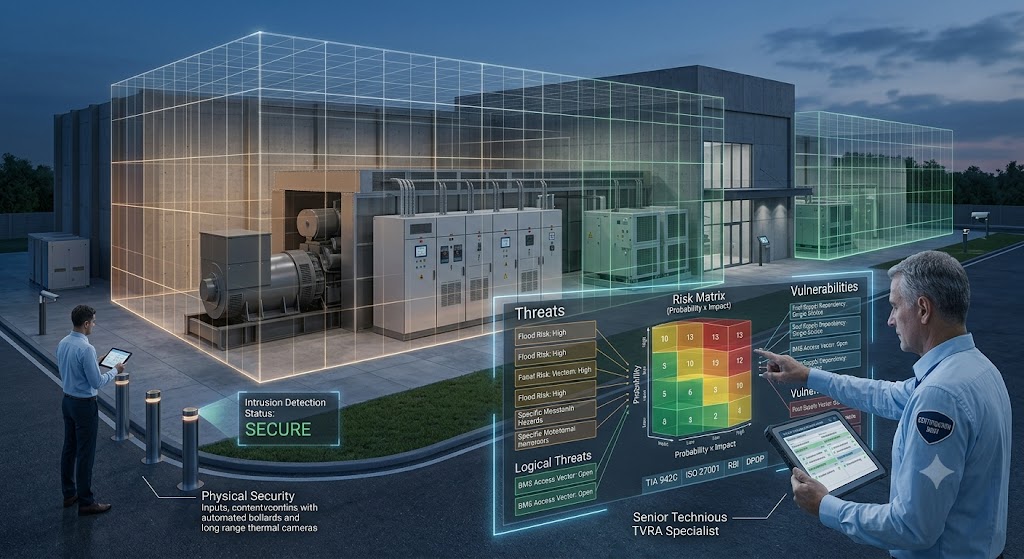
A rigorous data centre TVRA assessment covers five inter-related dimensions. Technavious’s methodology addresses each dimension systematically, drawing on engineering, compliance, and operational expertise across all five areas.
1. Physical Security
Assessment of the physical protection measures in place against intrusion, theft, sabotage, and unauthorised access. This covers perimeter security, access control layering (mantraps, biometric controls, CCTV), visitor management, loading bay security, and the physical resilience of the building envelope. Vulnerabilities identified here feed directly into TIA 942C architecture requirements and ISO 27001 physical security controls. Data centre operational resilience assessment India must begin with the physical layer, since physical vulnerabilities can undermine even a technically sophisticated logical security programme.
2. Logical and Cyber Threat Surface
While a TVRA is not a penetration test, it must address the logical attack surface that intersects with physical infrastructure. This includes out-of-band management networks, building management systems (BMS), fire suppression control systems, and DCIM platforms. Each of these represents a potential attack vector that could cause physical consequences including HVAC manipulation, false fire suppression activation, and UPS bypass. The TVRA maps these intersections and assesses the risk of each. Mitigating data centre operational risk in this dimension requires both technical controls and the procedural frameworks that govern access to these systems.
3. Environmental and Natural Hazard Threats
Assessment of the facility’s exposure to environmental risks: flooding, seismic activity, extreme heat events, lightning, dust ingress, and power quality issues from the utility supply. In the Indian context, regional environmental risk profiles vary significantly. A facility in coastal Mumbai faces different flood and humidity risks than one on the Bengaluru plateau or in the National Capital Region. The TVRA must be site-specific rather than templated. A generic environmental risk assessment does not satisfy the requirements of TIA 942C, ISO 27001, or the RBI framework.
4. Operational and Human Threat Factors
Human error is consistently among the highest-probability risk factors in data centre operations, and it is also among the most manageable with the right procedural frameworks in place. The TVRA assesses procedural vulnerabilities across change management processes, maintenance procedures, staff access controls, contractor management, and the adequacy of documented operating procedures. It also addresses insider threat risk, specifically the probability and potential impact of deliberate harmful action by authorised personnel. Data centre audit and compliance
programmes that omit this dimension are incomplete, regardless of how thorough the technical assessment is.
5. Supply Chain and Third-Party Dependencies
Data centres are critically dependent on third parties: utility providers, fuel suppliers, hardware vendors, managed service providers, and network carriers. The TVRA maps these dependencies and assesses the risk associated with each, including the probability of disruption, the likely duration of impact, and the adequacy of contractual protections and operational contingencies. Supply chain resilience is an area of increasing regulatory scrutiny across all sectors, and the TVRA provides the documentary basis for demonstrating that third-party dependencies have been formally assessed.
Once threats and vulnerabilities are identified, each combination is assessed using a structured risk scoring methodology. Risk is a function of probability, specifically how likely the threat is to materialise against the vulnerability, and impact, meaning what the consequence would be for the facility, its operations, and its customers? The output of the scoring process is a prioritised remediation register, which becomes the working document for risk management and the primary deliverable referenced during regulatory audits and certification assessments.
| Threat Category (example) | Probability | Impact | Risk Rating | Mitigation Priority |
| Unauthorised physical access via contractor | Medium | High | HIGH | Immediate: access control review |
| Single utility feed failure | Low-Medium | Critical | HIGH | Immediate: dual feed assessment |
| BMS remote access exploitation | Low | High | MEDIUM | Short term: network segmentation |
| Fuel supply disruption (>72 hours) | Low | Critical | MEDIUM | Medium term: supplier diversification |
| Seismic event (low-risk zone) | Very Low | Critical | LOW | Monitor: structural review on schedule |
Technavious’s data centre TVRA assessment engagements are designed to produce outputs that are operationally useful, regulatorily defensible, and directly linked to certification pathways. A standard Technavious TVRA engagement produces a facility risk register covering all identified threats and vulnerabilities, scored and prioritised by risk rating. It also delivers a remediation action plan with specific, time-bound actions for each risk above the agreed risk appetite threshold, assigned to responsible parties. The TVRA report is formal documentation of the methodology, scope, findings, and
conclusions, suitable for submission to regulators, insurers, investors, and data centre certification bodies. Compliance mapping cross-references TVRA findings against TIA 942C, ISO 27001 data centre India requirements, the RBI IT risk framework, DPDP, PCI-DSS, and other applicable standards. An executive summary provides a concise, non-technical summary for leadership and board-level audiences.
Where Technavious is engaged for integrated lifecycle services, the TVRA is embedded from the planning phase, ensuring that design decisions address identified risks from the outset rather than requiring physical remediation of a completed facility. This integration between TVRA findings and design decisions is one of the clearest practical benefits of working with a data centre specialist India that spans both risk assessment and engineering design.
One of the most common misunderstandings about TVRA is that it is a project deliverable, something done once, documented, and filed. The threat and vulnerability landscape facing a data centre facility changes continuously. New regulatory requirements create new compliance obligations. Infrastructure changes alter the risk profile. The external threat environment evolves, bringing new attack methodologies, updated environmental risk data, and new supply chain vulnerabilities. Operational changes, including new staff, new contractors, and revised procedures, affect human risk factors. A TVRA conducted once and not subsequently maintained is a historical document, not a risk management tool.
Best practice, and increasingly regulatory expectation, is that TVRA is conducted on a defined cycle, annually for high-rated facilities or triggered by significant change events, and the the risk register is maintained as a living document reviewed on a quarterly basis. Data centre operational resilience India is not an outcome that can be achieved through a single assessment; it is a state that must be actively maintained through ongoing risk management.
Technavious offers a managed TVRA service. This is an annual review programme that maintains the risk register, tracks remediation progress, updates the risk assessment for changes to the facility or regulatory environment, and provides the documentation required for regulatory submissions and certification renewals. CAPA for compliance, meaning corrective and preventive action tracking, is built into this programme, ensuring that identified risks are not just recorded but actively managed to closure.
Most data centre operators in India can describe their infrastructure in considerable detail. Far fewer can answer with confidence the question that regulators, certifiers, and major customers are increasingly asking: what are the three highest-probability
risks facing this facility, and what is the current status of mitigation for each? A data centre TVRA assessment answers that question formally, defensibly, and in a format that satisfies regulators, certifiers, insurers, and customers. For organisations in regulated industries, it is rapidly becoming a pre-condition for compliance demonstration rather than an optional element of a certification programme.
Technavious commissions TVRAs as standalone engagements and as part of integrated certification and lifecycle programmes. Whether a facility is at design stage, recently commissioned, or a brownfield environment requiring risk rationalisation, a TVRA can be scoped to the specific context and integrated with the broader compliance programme. The data centre TVRA assessment India that Technavious delivers is not a template exercise. It is a site-specific, methodology-driven assessment conducted by engineers and compliance specialists who understand both the technical infrastructure and the regulatory environment in which it operates.
Over seventy clients across fifteen countries have trusted Technavious with their most significant data center builds.