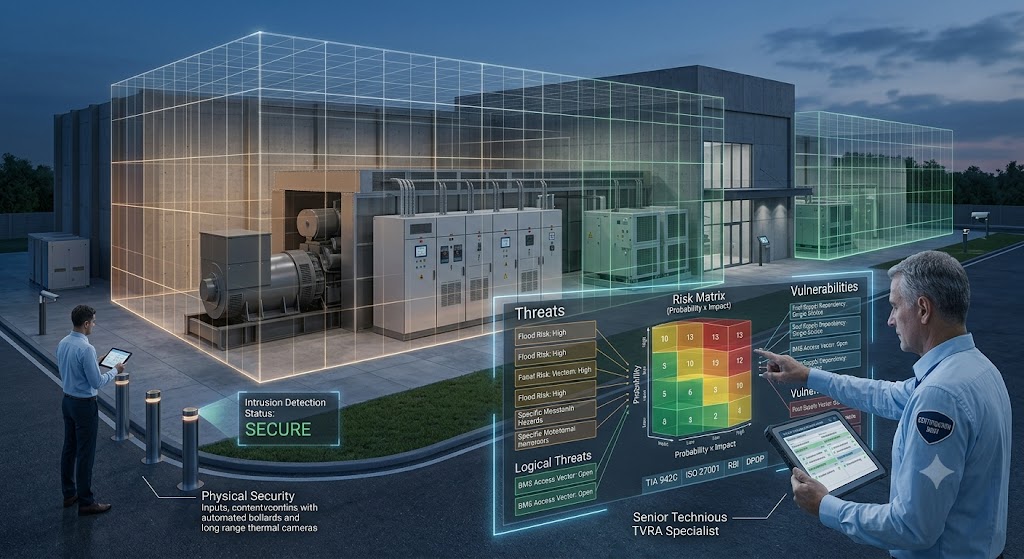
At some point in the lifecycle of every serious data centre, whether a captive enterprise facility, a colocation deployment, or a hyperscaler edge node, the question of TIA 942 certification India becomes unavoidable. A regulator asks for it. An investor requires it. An insurer prices against it. A customer demands proof before committing their workloads. The question arrives from multiple directions, often simultaneously, and the organisations best prepared to answer it are those that understood TIA 942C before it was demanded of them rather than after.
In India, TIA 942C has become the benchmark that sophisticated operators reference most consistently. Yet despite the frequency with which it appears in project conversations, very few people on the client side have a clear picture of what TIA 942C actually is, how the certification process works, who is authorised to issue the certificate, and what it means for the day-to-day operation of a certified facility. This article answers those questions plainly. It is written for data centre operators, enterprise IT leaders, BFSI compliance officers, investors, and developers who need to understand TIA 942C as a framework that, applied correctly, protects infrastructure investment and provides a verifiable, internationally recognised standard of operational excellence.
TIA 942C is the current revision of ANSI/TIA-942, the Telecommunications Infrastructure Standard for Data Centers. Developed by the Telecommunications Industry Association (TIA) and accredited by the American National Standards Institute (ANSI), it defines the engineering, design, and operational requirements that a data centre must meet to achieve certification at one of four Rated levels. For organisations asking what is TIA-942 and how it differs from a general compliance framework, the distinction matters.
TIA 942C is not a design guideline. It is a certification standard with specific, auditable requirements. It is not a self-assessment. Certification can only be issued by an authorised ANSI/TIA Certification Body after an independent audit. It is not the same as Uptime Institute TIER certification. TIA 942 and Uptime TIER are separate, independent frameworks with different methodologies and scopes. And it is not a one-time award. Maintaining certification requires periodic re-assessment and demonstrated operational compliance.
These distinctions matter because organisations frequently engage consultants for TIA 942 assessments that produce a report but no certificate, either because the consultant is not an authorised data centre certification body, or because the scope covered only design rather than the full as-built facility. A report is not a certificate, and a certificate issued by an unauthorised body carries no regulatory standing. Understanding this distinction is the starting point for any organisation considering TIA 942 certification India in a form that will satisfy regulators, investors, and customers.
TIA 942C defines four Rated levels of certification, each representing a progressively higher standard of availability, redundancy, and resilience. The framework applies across four subsystems: architecture, electrical, mechanical, and telecommunications. The ratings are not interchangeable with Uptime Institute Tier designations, though they are often compared in shorthand. Each framework uses its own methodology, and a Rated 3 under TIA 942C is not equivalent to a Tier III under Uptime, despite the numerical similarity.
| Rating | Availability | Redundancy Model | Typical Use Case |
| Rated 1 | 99.671% | Basic capacity (N) | Basic enterprise IT , single path power and cooling |
| Rated 2 | 99.741% | Redundant components (N+1) | Enterprise with scheduled maintenance windows |
| Rated 3 | 99.982% | Concurrently maintainable (N+1 with dual paths) | Colocation, BFSI, regulated industries , most common certification target |
| Rated 4 | 99.995% | Fault tolerant (2N) | Mission-critical operations , financial exchanges, defence, healthcare |
The Rated 3 TIA 942 standards are the most commonly targeted level for Indian colocation and BFSI operators, and for good reason: the concurrently maintainable infrastructure they require provides the availability levels that regulated industries demand, without the capital expenditure required for a fully fault-tolerant Rated 4 design. Targeting the right Rating for the actual business requirement is one of the most important decisions in the certification journey, and it is best made at the planning stage rather than after design has commenced.
This is the most critical and most frequently misunderstood aspect of TIA 942C certification. Only organisations that have been accredited as ANSI/TIA Certification Bodies are authorised to issue TIA 942C Rated Certificates. As of 2026, there are eight such bodies globally. Technavious is one of those eight, and it is the only ANSI/TIA Certification Body headquartered in India.
The implications of this are significant and practical. Any TIA 942 certificate issued by an organisation that is not among the eight authorised Certification Bodies is not a
valid TIA 942C Rated Certificate, regardless of how the report is titled or presented. Engaging an Indian data centre certification consultant who offers TIA 942 compliance advisory is not the same as engaging a Certification Body. The consultant may produce a useful report, but they cannot issue a certificate. For organisations in regulated industries, where regulators, insurers, and enterprise customers specify TIA 942C certification in their contracts and procurement frameworks, the distinction between a consultant’s report and a valid certificate is the difference between satisfying the requirement and failing to do so.
The only way to obtain a valid TIA 942C Rated Certificate in India without engaging an international Certification Body, and incurring the associated cost, travel overhead, and timeline implications, is to work with Technavious as the data centre certification body India.
Understanding the certification process helps project teams plan realistic timelines and avoid the most common delays. The TIA 942 design vs facility certification journey has five stages, and the most important insight is that engaging certification expertise early, at design stage rather than at completion, consistently produces better outcomes at lower cost.
Stage 1: Pre-Certification Gap Assessment
Before committing to full certification, most clients commission a data center gap assessment. This is a structured review of the existing design or facility against TIA 942C requirements for the target Rated level. The assessment identifies non-conformances, prioritises remediation, and provides a realistic view of what is required to achieve certification. For new builds, this is most effectively done at the conceptual design stage, before engineering commitments have been made.
Stage 2: Design Certification Review
The Certification Body reviews the engineering design documentation, including architectural drawings, electrical single-line diagrams, mechanical schematics, and ELV documentation, against TIA 942C requirements for the target Rating. Non-conformances are issued, the design team addresses them, and a Design Certification Letter is issued when the design meets the standard. TIA 942 compliant design India requires this design certification to demonstrate that the engineering intent aligns with the standard before construction begins.
Stage 3: Construction Monitoring
For new builds and major upgrades, ongoing construction monitoring ensures that the as-built facility reflects the certified design. Deviations during construction are identified and addressed before they become as-built non-conformances, avoiding the
expensive surprises that occur when certification is deferred to the final stage of a project. This is where embedded lifecycle involvement pays its clearest dividend.
Stage 4: As-Built Site Audit
An authorised auditor from the Certification Body conducts a physical site audit of the completed facility. The TIA 942C audit India covers all four subsystems, namely architecture, electrical, mechanical, and telecommunications, and produces a formal audit report. Non-conformances identified at this stage must be remediated before the certificate can be issued.
Stage 5: Certificate Issuance
Where all requirements are met and non-conformances resolved, the Certification Body issues a TIA 942C Rated Certificate. The certificate specifies the facility, the Rated level achieved, the date of certification, and the issuing Certification Body. The certificate is valid for a defined period, subject to periodic re-assessment. TIA 942 certification cost India varies with the size and complexity of the facility, the target Rating, and the scope of construction monitoring included. These are factors best discussed at the gap assessment stage.
Both TIA 942C and Uptime Institute TIER are internationally recognised data centre certification frameworks. The comparison between TIA-942 vs Uptime Institute Tier standards comes up frequently in project discussions, and the two frameworks are often confused or treated as interchangeable. They are not.
| Dimension | TIA 942C | Uptime Institute TIER |
| Governance body | ANSI / TIA (USA) | Uptime Institute (USA) |
| Framework levels | Rated 1, 2, 3, 4 | Tier I, II, III, IV |
| Scope | Architecture, electrical, mechanical, telecom | Topology, site infrastructure, operational sustainability |
| Certification issuer | 8 authorised ANSI/TIA Certification Bodies globally | Uptime Institute only |
| Design vs. as-built | Both , separate Design and Facility certificates available | Three-stage: Design, Constructed Facility, Operational Sustainability |
| Cost and timeline | Typically lower cost and faster for India-based projects with a local Certification Body | Higher cost; Uptime engages directly; no local certification body in India |
| Regulatory acceptance | Widely accepted by RBI, SEBI and enterprise procurement in India | Accepted internationally; referenced by some enterprise contracts |
Neither framework is objectively superior. The right choice depends on the regulatory environment, the customer base, and the specific requirements of the project. In many cases, Technavious has delivered both certifications for the same facility, since the design documentation required for TIA 942C also provides a strong foundation for Uptime Institute submissions. The two frameworks are complementary, and a facility pursuing both benefits from integrating the compliance documentation from the outset.
Based on Technavious’s experience across more than 50 data centre certification engagements, several failure patterns repeat most consistently. Understanding these patterns helps project teams avoid the most expensive mistakes.
Engaging Certification Too Late
Certification is not a final-stage activity. Organisations that engage a data centre certification consultant only after construction is complete expose themselves to post-build remediation costs that can be significant. TIA-942 design certification should be embedded from the design phase, not bolted on after the fact.
Confusing a Report with a Certificate
Many data centre audit services produce detailed reports but no certificate. These reports have value as advisory documents, but they do not satisfy requirements from regulators, investors, or customers who specify TIA 942C certification. The distinction between a consultant’s compliance report and a certificate issued by an ANSI/TIA Certification Body is fundamental, and confusing the two is the most common source of compliance programme failure in the Indian market.
Targeting the Wrong Rating
Rated 3 is the most common certification target for Indian data centres, but it is not always the right one. Some organisations over-specify, investing in Rated 4 infrastructure when their availability requirement is Rated 3, or under-specify by designing to Rated 2 and discovering mid-project that their regulator expects Rated 3. The data center gap assessment stage exists precisely to align the target Rating with actual business requirements before engineering commitments are made.
Assuming Design Certification Implies Facility Certification
A Design Certification Letter confirms that the engineering design meets TIA 942C requirements for the target Rating. It does not certify the as-built facility. Deviations during construction can, and regularly do, create non-conformances that require remediation before the facility certificate can be issued. TIA 942 design vs facility certification are two separate milestones, and the gap between them is where many projects encounter unexpected costs.
As India’s only ANSI/TIA data centre certification body, Technavious brings a structural advantage to the certification process: the team that assesses and certifies a facility is the same team that can design and build it. Most TIA Certification Bodies are assessment-only organisations. Technavious is not. The practical result is that TIA 942C requirements can be embedded in the design from day one, rather than discovered at the certification audit, and that a continuous compliance thread runs from planning through construction monitoring to final certificate issuance.
The data centre compliance services delivered by Technavious are designed to integrate with the broader certification landscape. TIA 942C certification can be
delivered alongside ISO 27001 data centre India, PCI DSS data centre compliance India, DPDP compliance, and SOC 2 in a single integrated programme, using shared documentation and aligned audit processes. This integration reduces total compliance cost, compresses timelines, and eliminates the most common failure mode in the Indian market: a certification body that arrives at a completed facility and finds problems that should have been addressed at design stage.