What a Bankable Feasibility Report Actually Covers
A data centre is one of the most capital-intensive infrastructure investments an organisation can commit to. In India, the all-in cost of a new greenfield facility, site acquisition, civil construction, MEP fit-out, IT infrastructure and commissioning, can run from Rs 50 crore for a modest enterprise deployment to several thousand crore for a hyperscaler-grade multi-megawatt campus. The decision to proceed is irreversible once the ground is broken.
Yet a surprising proportion of Indian data centre projects begin with feasibility work that is inadequate for the scale of the commitment being made. Desktop studies that do not account for utility constraints. Site selections made on the basis of land cost without power availability analysis. DPRs produced by teams that will not be involved in design or delivery, creating a document that serves an approval process rather than an engineering reality.
The consequences are predictable and expensive. Projects discover mid-design that the selected site cannot be served with the required utility power within the planned timeline. Brownfield conversions find that the structural loading of the existing building cannot support the intended rack density. New builds reach construction phase and encounter AHJ requirements that were not anticipated in the feasibility study, triggering redesigns that add months and crore to the project.
This article defines what a rigorous, bankable data centre feasibility report actually covers, and why the quality of feasibility work is the single most important determinant of whether a data centre project delivers on its original business case.
The term ‘feasibility study’ covers a wide range of deliverables, from a brief desktop analysis prepared in a week to a comprehensive Detailed Project Report (DPR) that serves as the foundation for engineering, financing and regulatory approvals. Understanding the difference matters because these are not interchangeable documents.
Desktop Feasibility Study
A desktop study typically covers high-level site assessment based on available data without physical survey, indicative power and utility availability based on published capacity without confirmed allocation, rough-order-of-magnitude capex estimates at plus or minus 30-40%, and a high-level project timeline. It is useful for early-stage go/no-go decisions but insufficient as the basis for a financial commitment or an engineering brief.
Bankable Detailed Project Report (DPR)
A bankable DPR is a document that can be presented to a lender, investor or board with confidence that its findings will hold under engineering and financial scrutiny. It is produced through physical site investigation, confirmed utility engagement, detailed capex modelling with identified contingencies, and review against local AHJ requirements. It is the document that converts a strategic intention into an investable project.
A rigorous data centre feasibility report produced by Technavious covers eight interconnected workstreams:
1. Site Selection and Assessment
Where multiple sites are under consideration, a structured methodology evaluates each against defined criteria: proximity to power substations, flood zone classification, seismic zone, connectivity (dark fibre availability, carrier diversity), land tenure, zoning permissibility for data centre operations, and physical constraints such as topography, drainage and access road capacity. The output is a ranked site comparison matrix with a recommended preferred site and documented rationale.
2. Power and Utility Analysis
Power is the single most critical constraint in Indian data centre development. The feasibility report must go beyond published utility capacity figures to confirm: the available connected load from the relevant DISCOM, the timeline for new or upgraded substation capacity where required, the HT/LT supply voltage options, and the redundancy configuration available from the utility. For large developments, feasibility must also assess the viability of captive power and the regulatory framework governing its use.
3. Connectivity and Carrier Analysis
A data centre without diverse, low-latency connectivity has limited commercial value. The feasibility report maps the available carrier ecosystem at the proposed site: which licensed telecom operators have fibre presence within economic reach, the diversity of physical routes available, and the latency profile to key connectivity hubs.
4. AHJ and Regulatory Requirements
Authority Having Jurisdiction requirements vary significantly by state and municipality in India. The feasibility report must identify the specific approvals required – building plan approval, fire NOC, environmental clearance, power connection approval, and any sector-specific licences, and provide a realistic timeline for each. Projects that discover AHJ complexity late in the design phase face timeline extensions that can materially affect the business case.
5. Structural and Civil Assessment (Brownfield)
For brownfield conversions or facility expansions, a structural assessment of the existing building is a prerequisite for feasibility. The assessment establishes the floor loading capacity, the ceiling height available for raised floor and overhead cable management, the structural system’s ability to accept rooftop mechanical equipment, and the condition of the existing MEP infrastructure.
6. Capex Modelling
A bankable capex model breaks down the total project cost into defined components: civil and structural works, electrical infrastructure (HT yard, transformers, switchgear, UPS, PDU, cabling), mechanical infrastructure (precision cooling, CRAC/CRAH, chillers, cooling towers), fire suppression, structured cabling and ELV, IT white space fit-out, and project management costs. Each component is estimated at a defined level of confidence, with contingency provisions explicitly stated.
7. Project Timeline
A realistic project timeline from financial close to commissioning must account for AHJ approval timelines, equipment procurement lead times (particularly for transformers and UPS systems, which carry long lead times in the Indian market), construction sequencing, and commissioning and certification durations.
8. Risk Register
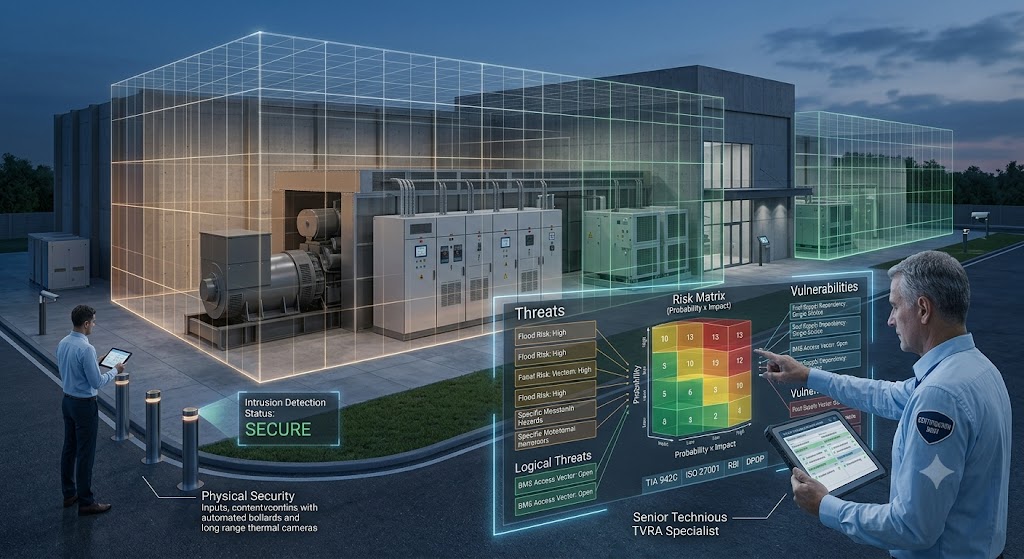
A bankable feasibility report includes a structured risk register covering the key risks to the project’s cost, timeline and technical assumptions, each with a probability assessment, potential impact and proposed mitigation. For investors and lenders, this demonstrates that the project sponsor has stress-tested their assumptions.
| What Investors Scrutinise | Why It Matters to Them |
| Power confirmation | Unconfirmed power allocation is the most common reason data centre projects are delayed. Investors want a confirmed allocation letter from the DISCOM or a captive power plan. |
| Capex confidence level | Plus or minus 30% desktop estimates are not acceptable for institutional due diligence. Plus or minus 10-15% engineering estimates are expected. |
| AHJ approval timeline | Regulatory approval delays are a primary source of timeline slippage. Investors want evidence that approval timelines have been validated, not assumed. |
| PUE and operational cost model | The long-term IRR of a data centre investment is highly sensitive to power cost and PUE. Investors will model multiple scenarios and expect the feasibility report to provide the inputs. |
| Certification pathway | Institutional investors increasingly require TIA 942C or equivalent certification as a condition of investment. The feasibility report should confirm the target certification level and design approach. |
The most common failure mode in Indian data centre feasibility is the handoff: a feasibility study is produced by one firm, and the design is commissioned from another. The design team inherits assumptions about site
constraints, utility interfaces and AHJ requirements that they did not validate themselves. When those assumptions prove incorrect, as they frequently do, the design must be revisited, and the project absorbs the cost.
Technavious’s lifecycle model eliminates this handoff. The engineers who produce the feasibility report are the engineers who design the facility. The power assumptions they validated are the power assumptions they design to. The AHJ requirements they identified are the requirements they design for. There is no translation loss, no re-validation cost, and no scope gap between what was planned and what was designed.
Over seventy clients across fifteen countries have trusted Technavious with their most significant data center builds.