A Practical Guide to Modernising Legacy Infrastructure Without Compromising Operational Continuity
Introduction: Why Brownfield Upgrades Often Fall Short
A brownfield data centre upgrade is fundamentally different from building a new facility. Unlike a greenfield project, where teams begin with a clean slate, a brownfield upgrade must be executed within the constraints of an operating environment. Existing infrastructure, live workloads, legacy systems, and business continuity requirements introduce layers of complexity that do not exist in new-build developments.
Despite this, many organisations approach brownfield projects using assumptions better suited to greenfield construction. Timelines are often underestimated, infrastructure dependencies are overlooked, and operational risks are discovered only after implementation has begun. The result is a familiar pattern of cost overruns, project delays, increased operational risk, and, in some cases, avoidable service disruption.
Successful brownfield modernisation requires a different mindset. It begins with understanding that the objective is not simply to deploy new infrastructure. The objective is to improve capability while maintaining stability across systems that are already supporting critical business operations.
Why Legacy Infrastructure Requires a Different Approach
The greatest challenge in any brownfield data centre upgrade is that every decision must account for existing conditions. Power systems are already carrying load. Cooling infrastructure is supporting production environments. Network architectures have evolved over years, often with limited documentation. Even seemingly straightforward changes can have consequences that extend far beyond the immediate scope of work.
Many project teams underestimate the extent of these dependencies during planning. They assume that documentation accurately reflects the current environment, that legacy systems behave as expected, and that infrastructure capacity can accommodate future requirements without detailed validation. These assumptions often prove costly.
Brownfield environments typically operate under several constraints:
· Existing infrastructure creates physical and operational limitations.
· Equipment refresh cycles are rarely aligned across systems.
· Technical debt accumulates over years of incremental changes.
· Documentation may be incomplete, outdated, or inconsistent.
· Business continuity requirements limit maintenance windows and implementation options.
These realities make careful planning essential.
| Aspect | Greenfield | Brownfield |
| Operational Impact Documentation Sequencing Risk Profile Testing | No live environment Developed during design Flexible deployment Construction-focused Pre-production | Must maintain uptime Often incomplete or outdated Phased and dependency-driven Operational and infrastructure-focused Must account for live systems |
1. Inadequate Infrastructure Assessment
The most common mistake is rushing through discovery and assessment.
Many organisations begin planning migrations and equipment deployments before developing a complete understanding of the existing environment. Electrical capacity, cooling distribution, cable infrastructure, structural limitations, and equipment dependencies are often assumed rather than validated.
Unfortunately, hidden dependencies rarely remain hidden for long. Load-sharing arrangements that were never documented, legacy systems that still support critical functions, or infrastructure constraints that were overlooked during planning often emerge midway through execution, when remediation becomes expensive and disruptive.
A comprehensive infrastructure assessment should identify:
· Hidden load-sharing arrangements across power systems.
· Legacy equipment that remains operational despite being absent from asset registers.
· Dependencies on obsolete infrastructure components.
· Capacity limitations within power, cooling, and network systems.
· Structural constraints affecting future expansion plans.
The discovery phase is often viewed as an area where time can be saved. In reality, it is one of the most valuable investments a project team can make.
2. Ignoring Cooling Constraints During Migration
Cooling infrastructure is frequently one of the most significant constraints in a brownfield environment.
Workload consolidation, server refresh programmes, and higher-density deployments can dramatically increase thermal loads within specific areas of a facility. Teams often focus heavily on available electrical capacity while giving less attention to cooling performance, only to discover thermal limitations once migration activities are underway.
This challenge becomes particularly acute when equipment is relocated between halls, racks are consolidated, or AI and high-performance computing workloads are introduced into environments originally designed for lower-density deployments.
To reduce risk, organisations should:
· Conduct detailed thermal modelling before migration begins.
· Assess cooling capacity at a zone level rather than a facility level.
· Identify potential hotspots during transitional phases.
· Deploy supplementary cooling infrastructure where necessary before migration activities commence.
· Validate cooling performance throughout implementation rather than waiting until completion.
Cooling limitations discovered during execution are far more expensive to address than those identified during planning.
3. Underestimating Cable Management Complexity
Few aspects of a brownfield project create more operational risk than poorly understood cabling infrastructure.
Over time, cable pathways often become crowded, poorly labelled, and difficult to trace. Power, network, and fibre connections may have been modified repeatedly by different teams, with varying documentation standards and inconsistent labelling practices.
During an upgrade programme, these issues become critical. Teams may be unable to isolate equipment safely, trace dependencies accurately, or execute migration activities without introducing unnecessary risk.
Effective cable management should include:
· Comprehensive cable audits before project initiation.
· Physical verification of critical pathways.
· Photographic documentation of existing conditions.
· Fibre and power tracing activities where dependencies are unclear.
· Updated labelling and documentation standards throughout the project.
Many organisations underestimate the effort involved in untangling years of accumulated infrastructure changes. In practice, cable remediation often requires substantially more time than initially anticipated.
4. Weak Change Management and Risk Planning
Brownfield upgrades succeed or fail based on change management discipline.
Unlike greenfield projects, every activity within a brownfield environment has the potential to affect live operations. Even routine infrastructure modifications can create unexpected consequences if dependencies are not fully understood.
Yet change management remains one of the most frequently underdeveloped aspects of upgrade programmes.
Successful projects establish clear governance structures, robust approval processes, and thoroughly tested rollback procedures before implementation begins.
Key principles include:
· Developing rollback plans for every major activity.
· Testing recovery procedures before production implementation.
· Maintaining clear stakeholder communication throughout the programme.
· Defining ownership and escalation paths for every workstream.
· Conducting risk reviews before each implementation phase.
A change that cannot be reversed safely should not be executed.
Industry Reality
A comprehensive brownfield upgrade for a mid-sized data centre typically requires four to eight months from discovery through final implementation when assessment, planning, testing, and validation are completed properly.
Projects compressed into unrealistic timelines often achieve short-term schedule objectives at the expense of long-term operational stability. Many of the outages that occur during the first year following a major upgrade can be traced back to decisions made during accelerated implementation programmes.
Phase 1: Discovery and Assessment
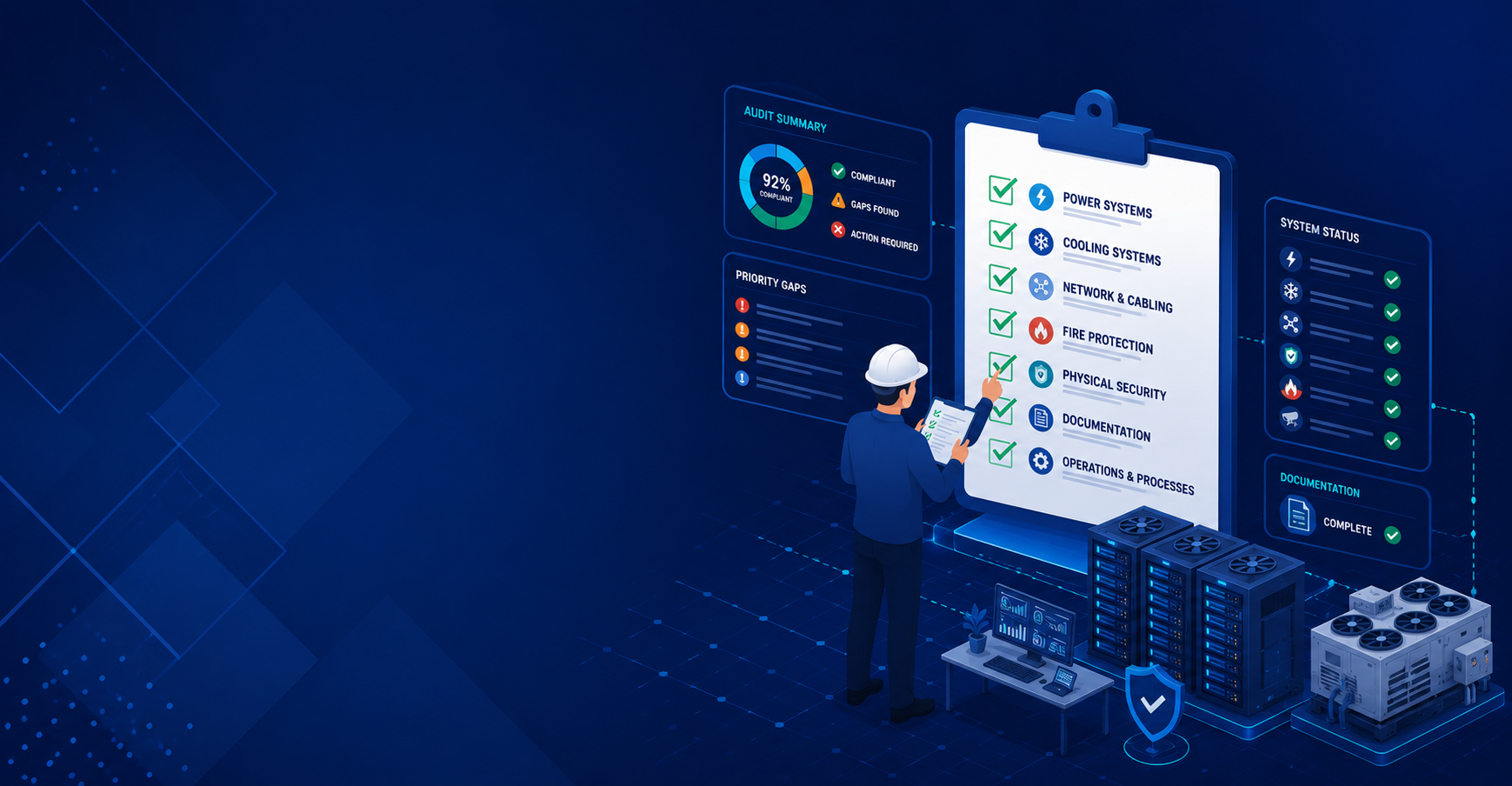
Every successful brownfield programme begins with a detailed understanding of the existing environment.
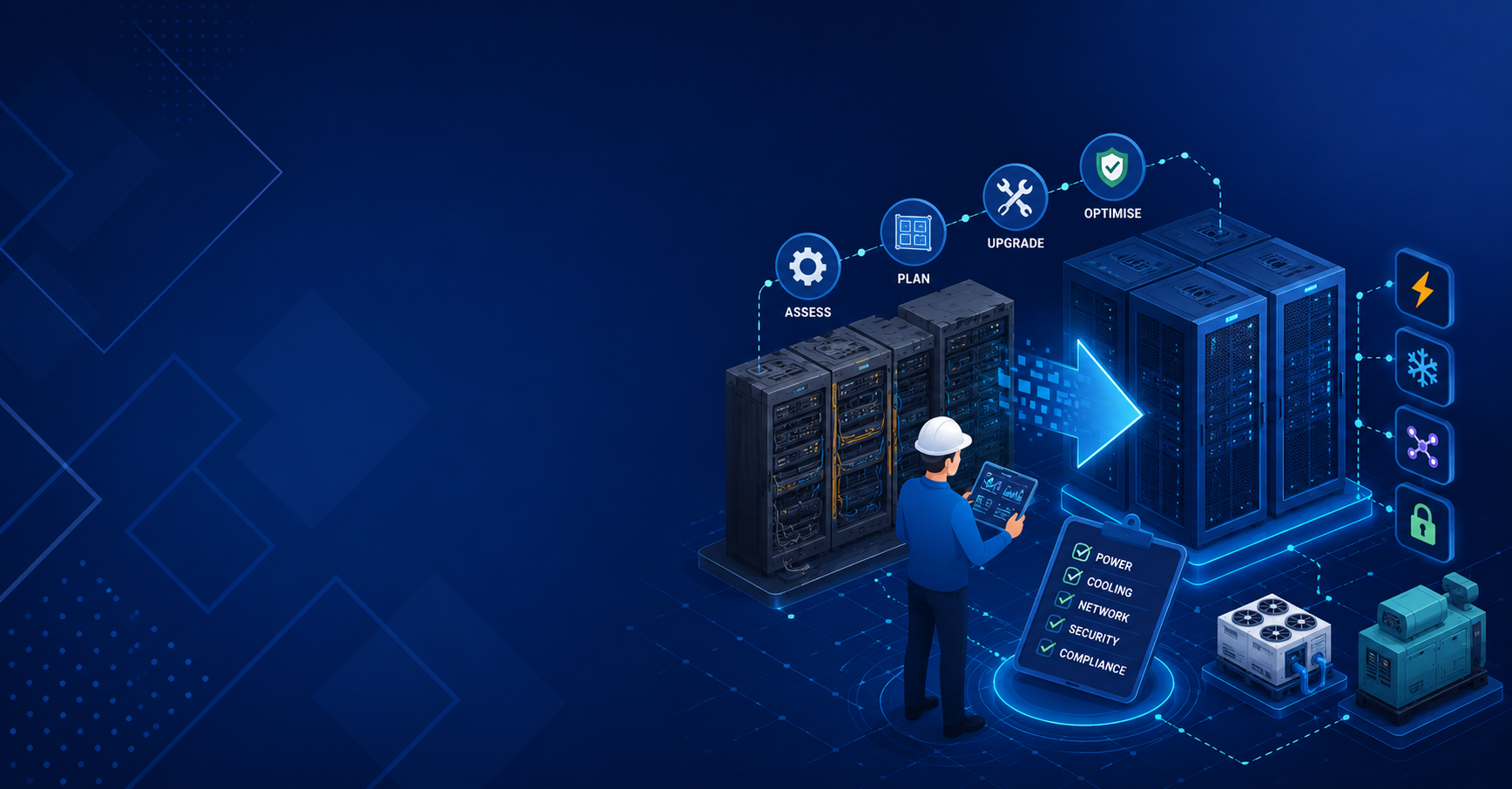
Power systems, cooling infrastructure, network architecture, security systems, fire protection systems, and operational processes should all be documented and validated. Current-state architecture diagrams should be created where they do not already exist.
The goal is to eliminate uncertainty before planning begins.
Phase 2: Phased Implementation
Large-scale upgrades should rarely be executed as a single event.
A phased approach allows workloads to be migrated gradually while maintaining operational resilience. Running legacy and upgraded infrastructure in parallel provides flexibility and reduces the impact of unforeseen issues.
This approach also simplifies testing and enables rollback if required.
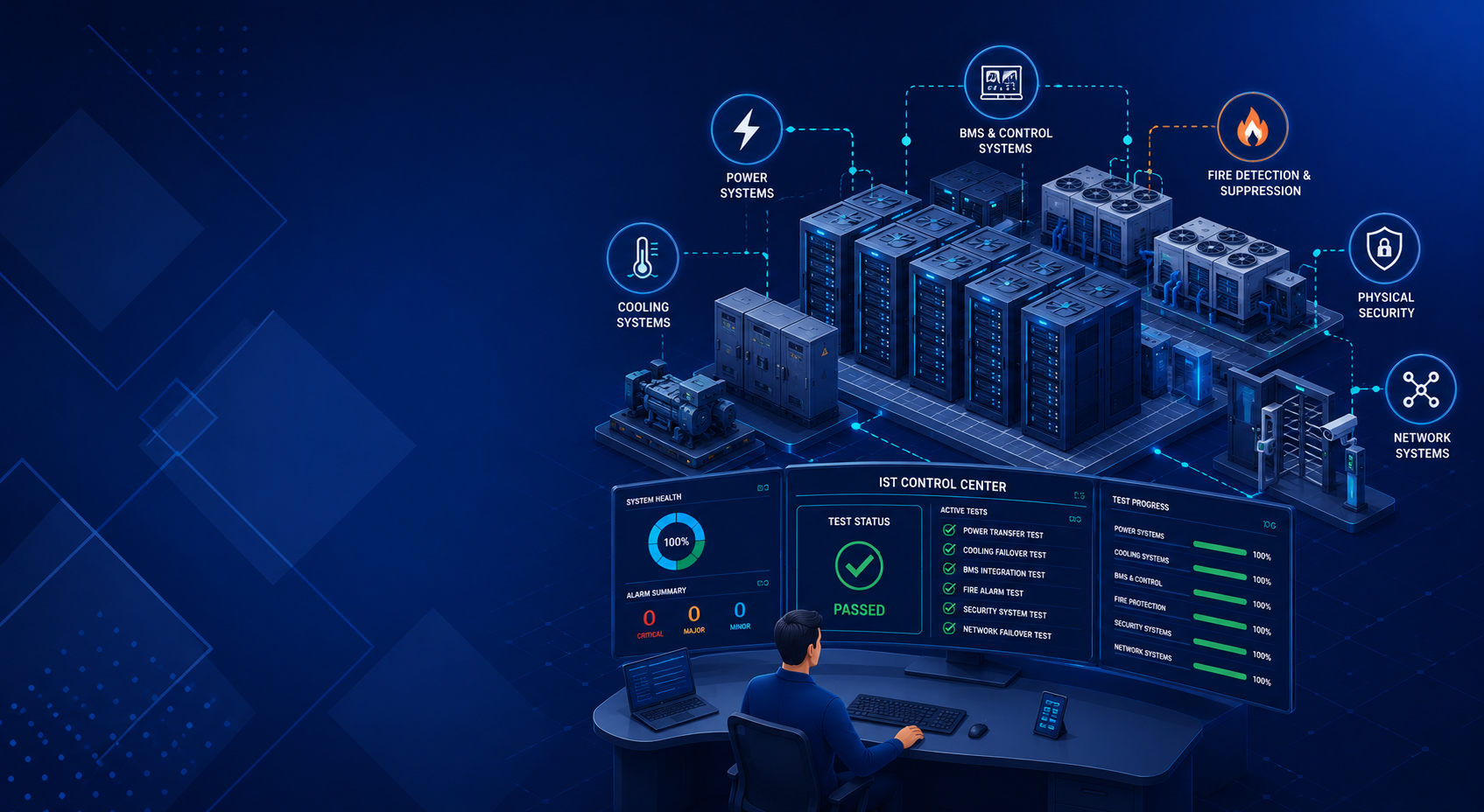
Phase 3: Continuous Validation
Validation should not be treated as a final project activity.
Infrastructure performance should be monitored throughout execution, with electrical capacity, cooling performance, network utilisation, and operational metrics tracked continuously.
Performance baselines established during discovery provide an objective reference point for identifying anomalies before they become operational incidents.
A financial services organisation planned to consolidate three legacy racks into a single high-density rack as part of a broader infrastructure modernisation programme.
Initial electrical assessments suggested that sufficient power capacity existed within the target environment. However, detailed thermal modelling revealed that cooling capacity within the affected zone would be exceeded during peak processing periods.
Rather than proceeding and addressing issues later, the team deployed supplementary in-row cooling before migration commenced.
Although this increased project expenditure, it avoided a far greater risk. The cost of preventive action was insignificant compared with the potential operational disruption, SLA exposure, and reputational impact associated with an avoidable outage.
This example illustrates a common reality of brownfield projects. Capacity planning must consider power and cooling together. Focusing on only one dimension creates blind spots that can undermine an otherwise well-planned programme.
Key Takeaways
Brownfield data centre upgrades require a fundamentally different approach from greenfield developments. Existing infrastructure, operational dependencies, and business continuity requirements introduce complexities that demand careful planning and disciplined execution.
Comprehensive assessment and accurate documentation remain the foundation of every successful upgrade. Power, cooling, network infrastructure, and operational processes should be validated before implementation begins. Cooling constraints and cable management challenges deserve particular attention because they frequently emerge as hidden risks during migration.
A phased implementation strategy supported by rigorous change management, tested rollback procedures, and continuous validation provides the strongest foundation for maintaining operational continuity. Organisations that invest in discovery, planning, and risk management are significantly more likely to deliver modernisation programmes on time, within budget, and without disruption to critical business services.
Conclusion
Brownfield data centre modernisation is not simply an infrastructure project. It is an exercise in balancing transformation with operational stability.
Organisations that treat brownfield upgrades as extensions of greenfield methodologies often encounter avoidable challenges. Those that recognise the realities of legacy environments, invest in thorough discovery, and execute carefully sequenced implementation programmes consistently achieve better outcomes.
Successful upgrades are rarely defined by how quickly new infrastructure is deployed. They are defined by how effectively organisations modernise critical environments while preserving the reliability, resilience, and business continuity on which their operations depend.
Over seventy clients across fifteen countries have trusted Technavious with their most significant data center builds.