The Critical Validation Stage That Determines Whether a Data Centre Is Truly Ready for Operations
Introduction: The Difference Between Equipment That Works and Infrastructure That Performs
Most modern data centres undergo extensive testing before they become operational. Generators are commissioned, UPS systems are validated, cooling equipment is tested, and control systems are configured. On paper, every critical component may appear ready for service.
Yet many operational incidents occur shortly after go-live despite successful commissioning activities.
The reason is simple. Individual systems may perform exactly as intended when tested independently, but data centres do not operate as isolated systems. They function as highly interconnected environments where electrical, mechanical, control, security, fire protection, and monitoring systems must work together under normal operating conditions and during failures.
Integrated Systems Testing, commonly referred to as IST, exists to validate this interaction.
It is the final and most comprehensive stage of data centre commissioning. More importantly, it is often the stage that provides the clearest indication of whether a facility is genuinely ready for operational service.
Organisations frequently invest significant time and resources in equipment testing while underestimating the importance of integrated validation. When project schedules come under pressure, IST is often compressed, reduced in scope, or partially deferred. Unfortunately, this is precisely where many future operational risks originate.
What Is Integrated Systems Testing?
Integrated Systems Testing is a structured commissioning process that evaluates how all critical infrastructure systems function together as a single operational environment.
Rather than focusing on individual equipment performance, IST validates the interactions between systems and confirms that they respond correctly under both normal and abnormal operating conditions.
The objective is not simply to verify that equipment works. The objective is to confirm that the entire facility performs as intended when faced with real-world operating scenarios.
A successful IST programme demonstrates that:
In practical terms, IST provides evidence that a facility can withstand operational events before those events occur in production.
Why IST Is Different from Traditional Commissioning
One of the most common misconceptions is that IST is simply another commissioning activity.
In reality, it serves a fundamentally different purpose.
Traditional commissioning focuses on validating individual systems. IST focuses on validating system interactions.
A UPS may pass every factory and site acceptance test. A generator may start successfully during commissioning. A cooling system may achieve its design performance targets.
None of these outcomes confirms that those systems will work together effectively during a utility outage, cooling failure, or operational emergency.
The distinction is critical.
| Testing Phase | Primary Objective | Limitation |
| Factory Acceptance Testing (FAT) | Verify manufacturer performance | Conducted in a controlled factory environment |
| Site Acceptance Testing (SAT) | Verify installation and functionality | Individual systems tested separately |
| Integrated Systems Testing (IST) | Validate system interaction and resilience | Requires all systems to operate together |
| Operational Readiness Testing (ORT) | Validate operational capability | Focuses on people and procedures |
Component testing answers the question:
“Does the equipment work?”
Integrated Systems Testing answers a more important question:
“Will the facility continue operating correctly when multiple systems interact during a real event?”
What Does a Comprehensive IST Programme Cover?
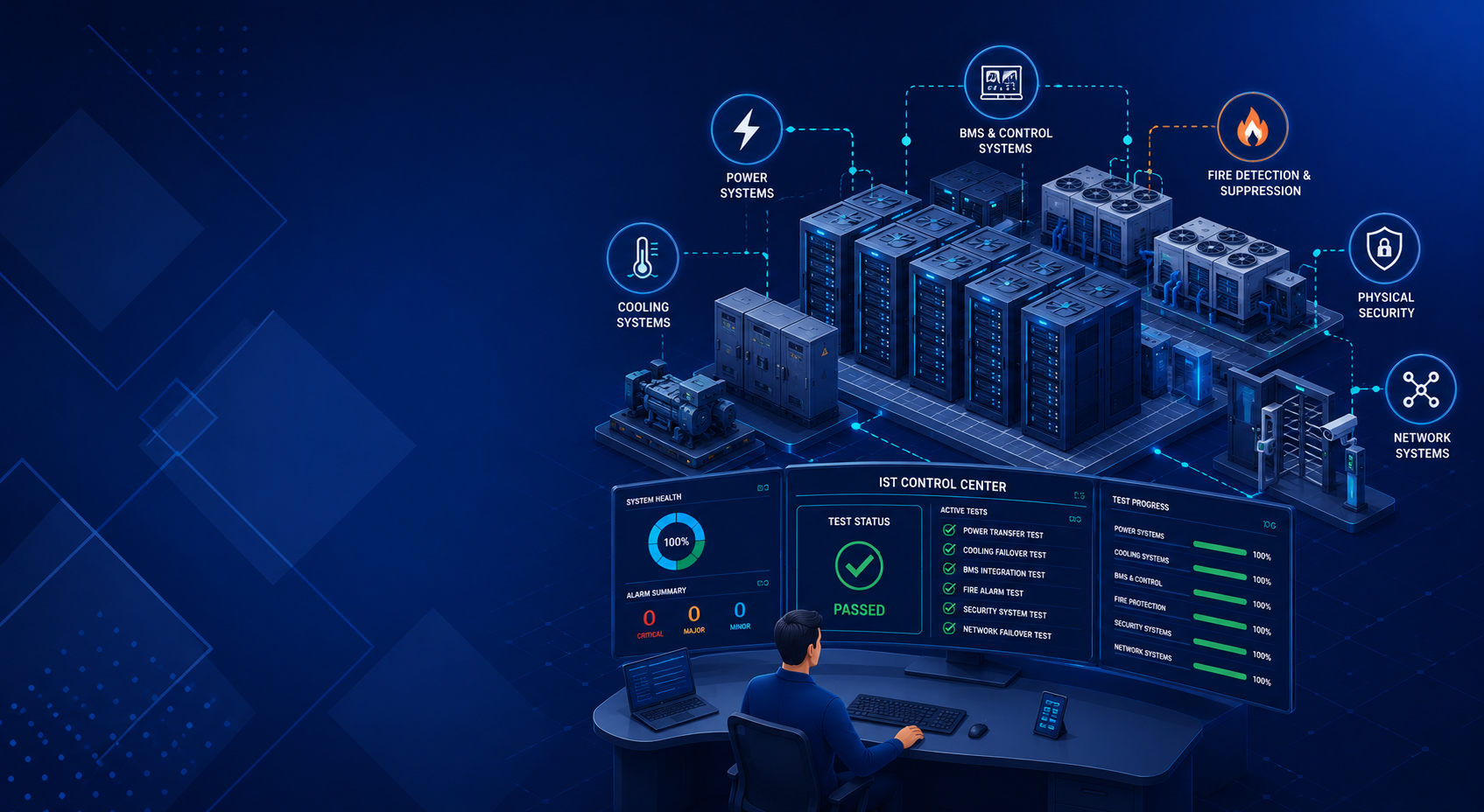
A well-executed IST programme simulates the conditions most likely to challenge the resilience of a data centre.
These scenarios are designed to replicate both normal operations and failure conditions.
Utility Failure and Generator Response
Power interruptions remain one of the most important scenarios tested during IST.
Typical validation activities include:
The goal is to confirm that the facility can maintain critical loads without interruption throughout the event.
UPS Failure and Electrical Resilience Testing
Power continuity depends heavily on UPS performance and redundancy.
IST scenarios commonly evaluate:
These tests help identify issues that may not appear during standalone equipment testing.
Cooling Failure and Redundancy Validation
Cooling systems are increasingly important as rack densities continue to increase.
IST programmes typically assess:
The objective is to confirm that cooling capacity can be maintained despite equipment failures or operational disturbances.
Building Management System Integration
The Building Management System acts as the operational nerve centre of a modern data centre.
Testing focuses on:
A surprising number of operational incidents can be traced to configuration issues that only become visible during integrated testing.
Fire Protection and Life Safety Integration
Fire protection systems interact with multiple facility components simultaneously.
IST validation typically includes:
These scenarios ensure that life safety functions operate correctly without creating unintended consequences elsewhere in the facility.
Why IST Is Frequently Compressed or Skipped
Despite its importance, IST is often one of the first activities affected when project schedules begin to slip.
By the time a project reaches the testing phase, construction delays, procurement challenges, client commitments, and commercial pressures have frequently consumed available schedule contingency.
Because IST occurs near the end of the delivery programme, it becomes a target for schedule recovery.
Organisations commonly respond by:
These decisions may appear reasonable in the short term, but they often create long-term operational risk.
The Real Cost of Inadequate IST
Many of the most disruptive post-handover incidents involve interactions between systems rather than failures of individual equipment.
Common examples include:
Undetected Interlock Failures
An individual system may perform correctly, yet fail when responding to signals from another system.
Delayed Power Transfer Events
Generators and transfer equipment may function independently but fail to achieve required performance under integrated load conditions.
Alarm and Monitoring Errors
Incorrect thresholds, escalation paths, or notification logic often become visible only when multiple events occur simultaneously.
Operational Confusion During Emergencies
Infrastructure may perform correctly while operational teams struggle to respond effectively because scenarios were never rehearsed under realistic conditions.
The financial impact of these failures can be significant.
For colocation operators, operational incidents can result in SLA penalties, customer dissatisfaction, reputational damage, and increased operational expenditure. For enterprise facilities, the consequences often include business disruption and loss of stakeholder confidence.
The cost of a comprehensive IST programme is typically insignificant when compared with the cost of a major operational incident.
Best Practices for Effective Integrated Systems Testing
Begin Planning During Design
IST should not be treated as a late-stage activity.
The test programme should be developed during design so that commissioning requirements align with the facility architecture.
Engage an Independent Commissioning Authority
Independent validation improves objectivity and strengthens confidence in the results.
The organisation responsible for IST should be separate from the EPC contractor and equipment suppliers wherever possible.
Test Under Realistic Conditions
Testing at representative load levels provides significantly more value than testing under minimal load conditions.
Realistic scenarios reveal behaviours that may not be visible during simplified testing.
Maintain Detailed Records
Every test should be documented thoroughly.
Data logs, event records, observations, and corrective actions provide valuable evidence for future audits, investigations, and operational reference.
Resolve Defects Before Handover
Critical findings should be corrected and retested before operational acceptance.
Deferring issues to post-handover activities transfers risk directly to operations teams.
Involve Operations Personnel
IST serves as both a validation activity and a learning opportunity.
Operations teams should participate actively so they understand infrastructure behaviour before the facility enters production service.
IST and the Indian Data Centre Market
The importance of Integrated Systems Testing continues to increase as India’s data centre sector expands.
Hyperscalers, financial institutions, government organisations, and enterprise customers are placing greater emphasis on resilience, reliability, and operational maturity. Many now request commissioning evidence, test reports, and defect closure documentation before occupancy.
Certification programmes are also placing greater emphasis on commissioning quality and operational readiness.
As a result, IST is no longer simply a technical exercise. It has become a commercial requirement that supports customer confidence, certification readiness, and long-term operational performance.
Key Takeaways
Integrated Systems Testing is the only commissioning phase that validates how critical infrastructure systems operate together under real-world conditions. It bridges the gap between individual equipment performance and actual facility resilience.
While component testing confirms that equipment functions correctly, IST confirms that the facility can withstand failures, execute automated responses, maintain critical loads, and recover safely during operational events.
The most serious data centre incidents often result from interactions between systems rather than isolated equipment failures. These are precisely the risks that IST is designed to identify before go-live.
Organisations that invest in comprehensive IST programmes consistently achieve stronger operational outcomes, improved reliability, greater certification readiness, and reduced post-handover risk.
Ultimately, a facility should not be considered operationally ready because every component has been tested. It should be considered ready only when the entire infrastructure ecosystem has demonstrated that it can perform reliably as an integrated whole.
Over seventy clients across fifteen countries have trusted Technavious with their most significant data center builds.