Introduction: The Stage Where Most Data Centres Quietly Fail
In many data centre projects, feasibility is treated as a preliminary exercise carried out before land acquisition or internal approvals. Attention then shifts to design, construction, and commissioning. This view overlooks a critical reality. Many operational challenges that emerge later in the project lifecycle originate during the feasibility stage. Across India, delayed expansions, cost overruns, operational inefficiencies, and even certification challenges can often be traced back to early decisions on site selection and feasibility assessment. A data centre located on a constrained power corridor may struggle to scale beyond its initial phase. A site exposed to flood risk can carry a long-term operational vulnerability regardless of how sophisticated the facility becomes. Similarly, limited network diversity can reduce the attractiveness of a facility to hyperscalers and enterprise tenants. By the time these constraints become visible, they are often expensive, difficult, or impossible to address. For this reason, a data centre feasibility study should not be viewed as a procedural requirement. It is the stage that determines what a project can realistically achieve throughout its operational life.
What Is a Data Centre Feasibility Report?
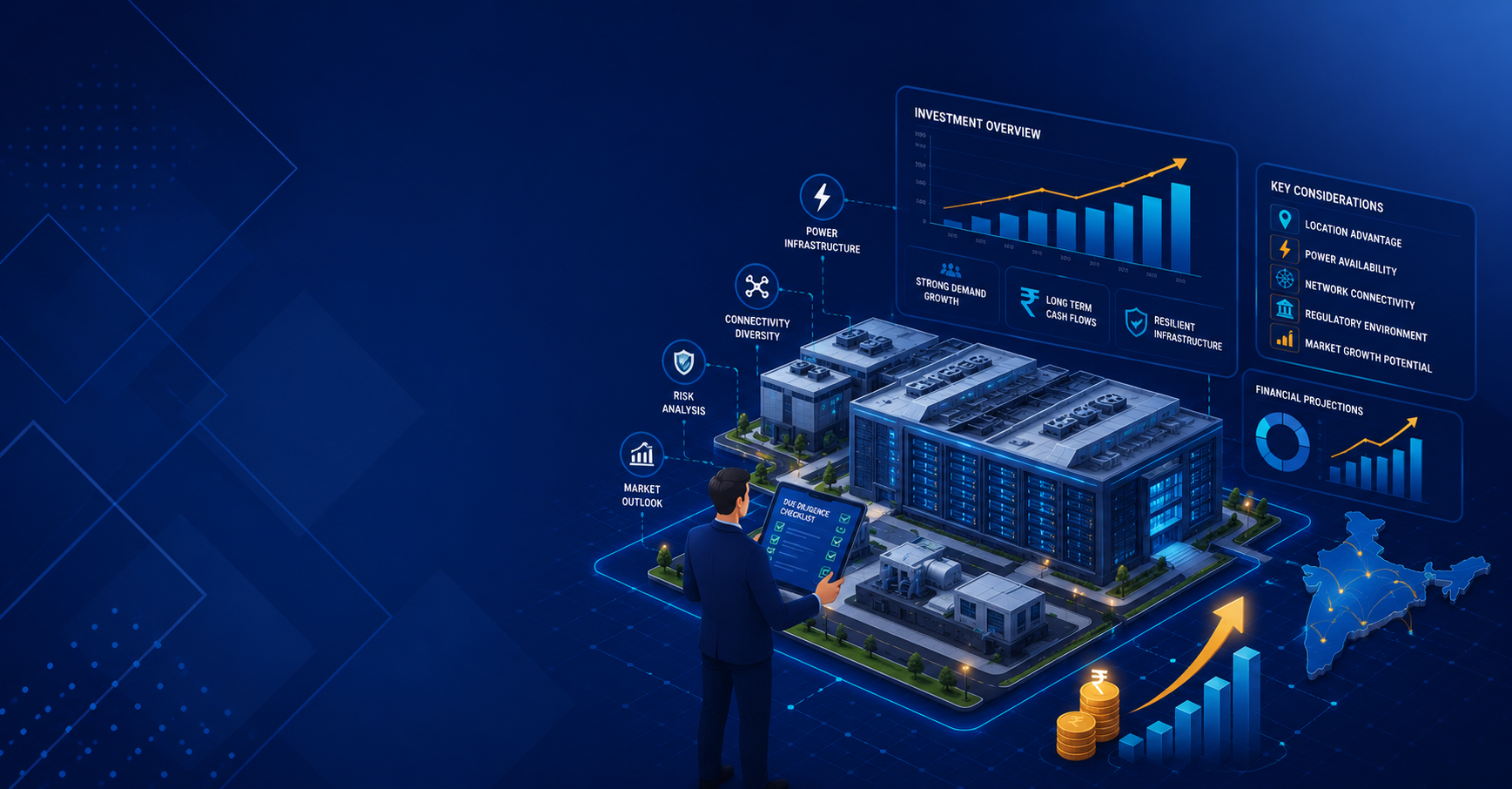
A data centre feasibility report is a structured technical, commercial, and regulatory assessment that determines whether a location can support a scalable, resilient, and economically viable data centre throughout its lifecycle. Unlike a conventional real estate feasibility study, a data centre feasibility assessment must evaluate multiple interdependent factors simultaneously. These include power infrastructure, network connectivity, environmental and physical site conditions, regulatory requirements, and future expansion capability. The objective is not simply to determine whether a site can be developed. It is to determine whether it can remain competitive, reliable, and commercially sustainable over time. The difference between a basic feasibility report and a rigorous one is not the volume of information collected. It is the quality of validation and the ability to identify future constraints before they become operational problems.
Why Feasibility Decisions Are So Hard to Reverse
Once a site has been selected, several constraints become effectively permanent. Power availability is tied to existing grid infrastructure and substation capacity. Fibre access
depends on available carrier routes. Environmental exposure is dictated by geography. Regulatory considerations are influenced by zoning and approval frameworks. Unlike design decisions, which can often be refined during execution, feasibility decisions establish the operating boundaries of the project. This is why experienced operators often say that a successful data centre is selected into success before it is designed into success.
The Five Parameters That Actually Decide Feasibility
1. Power Availability: The Primary Bottleneck in India
Power availability remains the most important factor in any data centre feasibility study in India. It is not simply a technical requirement. It directly influences IT load capacity, revenue generation, expansion potential, and long-term operational resilience. A thorough assessment should validate sanctioned load versus achievable load, the availability of independent power feeds, substation proximity and capacity, and the feasibility of future augmentation. Many projects assume power can be expanded later. In practice, grid augmentation can take years, making early validation essential.
2. Connectivity and Network Diversity: The Silent Differentiator
While power determines capacity, connectivity determines commercial viability. Data centres increasingly compete on network density, carrier diversity, and route resilience. A feasibility assessment should evaluate carrier availability, route diversity, and proximity to major fibre corridors or landing stations. Sites that depend on a single fibre route introduce network-level risk that hyperscalers and enterprise tenants typically seek to avoid.
3. Land Characteristics: Hidden Operational Risks
Not all industrial land is suitable for critical infrastructure. Flood history, drainage behaviour, soil bearing capacity, elevation, and seismic classification can have a direct impact on reliability, construction costs, and long-term operational performance. Facilities developed on low-cost sites often incur higher capital expenditure later because of corrective engineering measures required to address overlooked constraints.
4. Water Availability: An Emerging Site Selection Criterion
Water availability has become increasingly important as data centre densities continue to increase. Reliable cooling water supply, regulatory compliance, and long-term sustainability planning are now central components of a feasibility assessment.
In water-stressed regions, restrictions on water usage can affect future operational capacity. As a result, many hyperscalers now evaluate water sustainability alongside power and connectivity.
5. Regulatory Landscape: The Delay Multiplier
India’s regulatory environment involves multiple agencies at central, state, and local levels. A robust feasibility assessment should evaluate zoning compliance, environmental clearance requirements, power connection approvals, and fire and safety obligations. Projects frequently underestimate approval dependencies and the cumulative impact of sequential review processes. Even technically sound projects can face significant delays when regulatory complexity is not fully assessed during feasibility.
Common Feasibility Mistakes That Create Long-Term Risk
Several patterns appear repeatedly across Indian data centre projects. Organisations often prioritise land acquisition before validating power availability. Future grid expansion is assumed rather than confirmed. Connectivity is treated as a secondary consideration. Regulatory timelines are underestimated. Expansion planning focuses on Phase 1 while overlooking future growth requirements. These issues may appear minor during project initiation, but they can significantly affect scalability, resilience, tenant attraction, and long-term returns.
Industry Reality Check: Where Projects Actually Fail
Many underperforming data centres share a common characteristic. The selected site was sufficient to launch the project but not sufficient to support long-term growth. The consequences typically include constrained expansion, higher operating costs, increased environmental risk, and reduced attractiveness to premium tenants. By contrast, facilities built on well-selected sites generally achieve stronger uptime performance, higher tenant retention, and more efficient expansion cycles.
Best Practices: How to Execute Feasibility Correctly
A rigorous feasibility process should begin with power availability rather than land acquisition. Actual allocation should be validated rather than relying on indicative availability. Fibre routes should be physically assessed rather than inferred from carrier presence. Detailed flood, drainage, and soil studies should be completed early. Multi-phase expansion requirements should be incorporated into the analysis, and regulatory timelines should be evaluated using local expertise. Ultimately, feasibility should be treated as a risk reduction exercise. The earlier critical constraints are identified, the lower the cost and complexity of addressing them.
Key Takeaways
Feasibility decisions define the long-term potential of a data centre. Power availability and network connectivity remain the primary gating factors. Weak feasibility cannot be corrected through design excellence alone. Early-stage due diligence is one of the most cost-effective forms of risk mitigation available to project teams. The strongest-performing facilities are usually built on the most carefully selected sites, not simply the most sophisticated designs.
Over seventy clients across fifteen countries have trusted Technavious with their most significant data center builds.