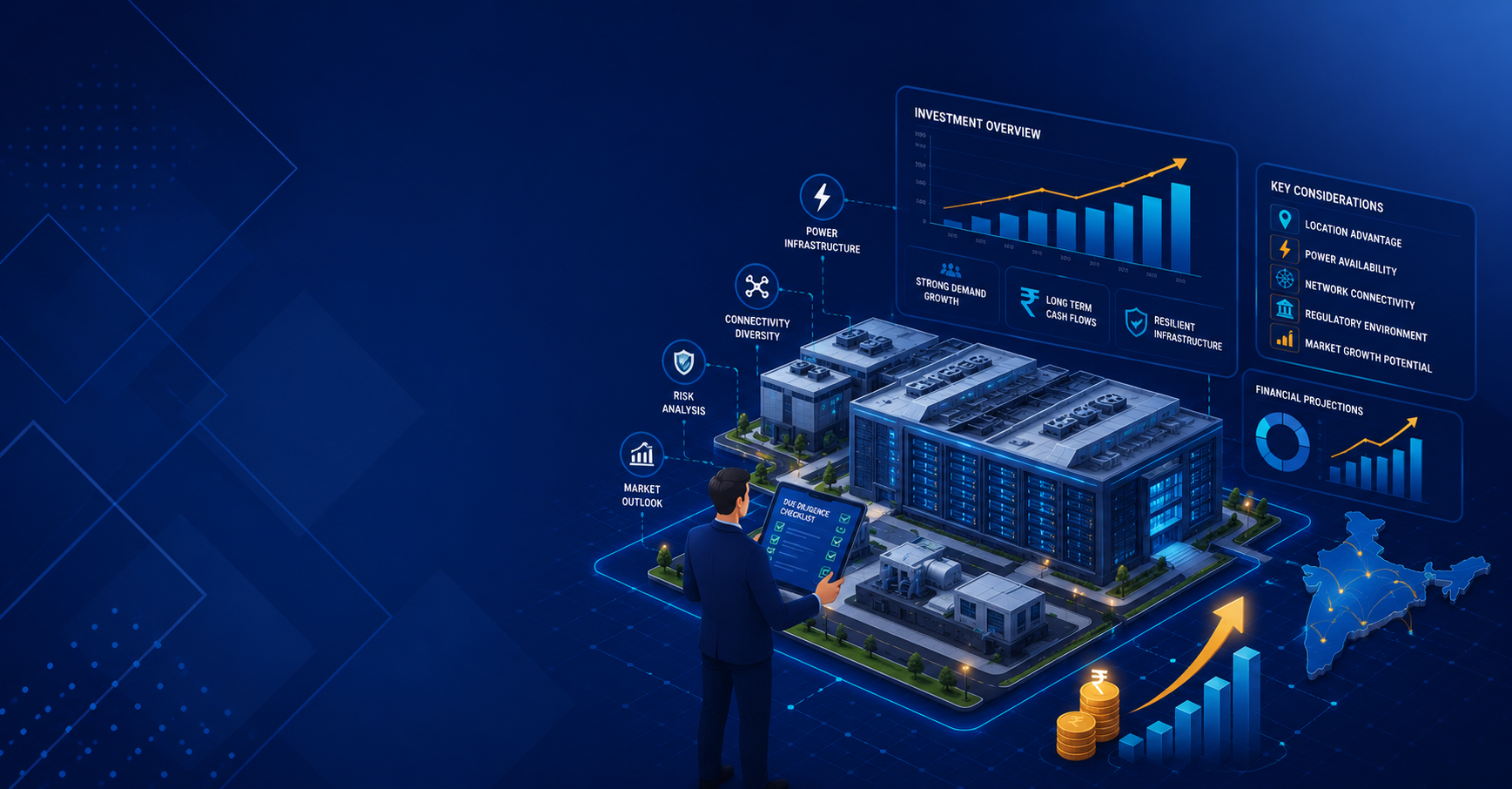
A Practical Framework for Evaluating Data Centre Investments in One of the World’s Fastest-Growing Digital Infrastructure Markets
Introduction: Why India’s Data Centre Market Continues to Attract Global Capital
India’s data centre industry has become one of the most attractive digital infrastructure investment opportunities in the Asia-Pacific region. Accelerating digital adoption, rapid cloud migration, government-led digital initiatives, and increasing demand for data localisation have created strong long-term fundamentals that continue to attract institutional capital.
Global infrastructure funds, sovereign wealth funds, pension funds, private equity investors, real estate investment trusts, and strategic operators have all increased their focus on Indian data centre assets. The sector is viewed not only as a technology enabler but also as a critical infrastructure asset class capable of generating long-term, stable cash flows.
However, investing in data centres requires a different approach from investing in traditional commercial real estate or industrial assets. Data centres combine real estate, critical infrastructure, engineering systems, technology platforms, utility dependencies, and long-term customer relationships within a single operating environment.
As a result, conventional investment due diligence frameworks often fail to identify the factors that ultimately determine asset performance and value.
This guide outlines the key areas that investors should evaluate when assessing Indian data centre opportunities, whether through greenfield developments, operating asset acquisitions, platform investments, or strategic partnerships.
Understanding the Indian Data Centre Investment Thesis
Strong Demand Fundamentals
The long-term investment case for Indian data centres is supported by several structural demand drivers.
India has one of the world’s largest digital populations, with internet adoption continuing to expand beyond major metropolitan centres. Cloud adoption across enterprise sectors continues to accelerate, while government digital initiatives are generating unprecedented volumes of data that require local processing and storage.
Several factors are driving sustained demand:
· Continued growth in internet and smartphone adoption.
· Expansion of cloud and hybrid IT environments.
· Increasing use of digital public infrastructure.
· Data localisation requirements and regulatory developments.
· Growth in artificial intelligence and high-performance computing workloads.
· Expansion plans by hyperscale cloud providers.
· Increasing enterprise focus on digital transformation.
Unlike cyclical real estate sectors, many of these demand drivers are structural and expected to remain relevant for years to come.
The Role of Data Localisation
One of the most important considerations for investors is the increasing emphasis on sovereign data management and local infrastructure capacity.
As organisations seek to comply with evolving regulatory requirements and maintain greater control over critical data, demand for domestic storage and processing infrastructure continues to strengthen.
This trend supports long-term occupancy and investment demand across multiple sectors, including financial services, healthcare, telecommunications, government, and digital commerce.
Market Concentration Creates Both Risk and Opportunity
India’s data centre capacity remains concentrated within a relatively small number of metropolitan markets.
Mumbai continues to dominate installed capacity due to its connectivity ecosystem, hyperscale demand, and submarine cable infrastructure. Chennai, Hyderabad, Pune, and Delhi NCR are also important markets, each with distinct advantages and challenges.
For investors, market concentration creates two important considerations.
First, concentration increases exposure to location-specific risks such as power constraints, environmental events, infrastructure bottlenecks, and regulatory changes.
Second, it creates opportunities in emerging markets where demand growth may outpace supply.
A strong investment thesis should evaluate both factors carefully.
Market-Specific Considerations
Mumbai
Mumbai remains India’s largest data centre market and continues to attract substantial hyperscale investment.
Key strengths include:
· High customer demand.
· Extensive carrier ecosystem.
· International connectivity through submarine cable landing stations.
Investors should also consider:
· Power cost volatility.
· Land availability constraints.
· Flood risk in certain locations.
· Increasing competition for development sites.
Chennai
Chennai has emerged as an important connectivity hub and benefits from relatively lower land costs.
Key considerations include:
· Strong submarine cable connectivity.
· Growing enterprise and cloud demand.
· Exposure to cyclonic weather conditions.
· Long-term water availability considerations.
Hyderabad
Hyderabad continues to attract technology investment and benefits from strong government support.
Investors should assess:
· Utility dependency risks.
· Future power infrastructure requirements.
· Market maturity relative to Mumbai and Chennai.
Delhi NCR
Delhi NCR offers strong demand from government, financial services, and enterprise sectors.
However, investors should evaluate:
· Power cost structures.
· Environmental considerations.
· Seismic exposure.
· Long-term infrastructure expansion plans.
Technical Due Diligence: The Foundation of Asset Value
Technical infrastructure ultimately determines the performance, resilience, and scalability of a data centre asset.
For investors, technical due diligence should extend beyond asset condition and focus on long-term operational capability.
Power Infrastructure Assessment
Power remains the single most important value driver in data centre investment.
Every investment thesis should begin with a detailed review of power infrastructure because power availability directly influences revenue potential, expansion capacity, and operational resilience.
Areas requiring validation include:
· Utility reliability and historical performance.
· Contracted versus available power capacity.
· Redundancy architecture.
· Future expansion capability.
· Open access energy arrangements.
· Generator infrastructure and fuel resilience.
· Long-term energy procurement strategy.
Many data centre projects experience delays because future power expansion assumptions prove unrealistic. Investors should validate actual capacity availability rather than relying solely on development plans.
Cooling Infrastructure Assessment
Cooling systems have become increasingly important as rack densities continue to increase.
Investors should evaluate:
· Historical and projected Power Usage Effectiveness (PUE).
· Cooling system efficiency.
· Water dependency and sustainability risks.
· Equipment age and remaining useful life.
· Capacity headroom for future growth.
· Maintenance and replacement planning.
Cooling limitations often become a constraint on future expansion long before power limitations emerge.
Structural and Site-Level Risk
Infrastructure resilience begins with site selection.
Due diligence should assess:
· Flood exposure.
· Seismic classification.
· Drainage conditions.
· Structural design capacity.
· Environmental risks.
· Expansion constraints.
· Physical security considerations.
A technically compliant facility today may face long-term operational challenges if underlying site conditions are not fully understood.
Commercial Due Diligence: Understanding Revenue Quality
Strong occupancy alone does not guarantee a strong investment.
Investors should evaluate the quality, durability, and diversification of revenue streams.
Customer Concentration Risk
Customer concentration remains one of the most important indicators of future cash flow stability.
Facilities heavily dependent on a small number of customers may experience lower vacancy risk in the short term but face greater renewal risk over the long term.
Key areas for assessment include:
· Weighted Average Lease Expiry (WALE).
· Revenue concentration.
· Customer credit quality.
· Expansion commitments.
· Early termination provisions.
· Historical retention performance.
Understanding who generates revenue is often as important as understanding how much revenue is generated.
Pricing and Contract Structure
Contract quality can significantly affect long-term returns.
Investors should evaluate:
· Escalation mechanisms.
· Power pass-through arrangements.
· Contract duration.
· Currency exposure.
· Market competitiveness.
· Expansion rights.
· Renewal structures.
A facility operating at full occupancy today may face challenges tomorrow if pricing structures do not reflect market realities.
Regulatory and Policy Risk Assessment
Regulatory considerations play an increasingly important role in investment decision-making.
Data and Compliance Requirements
Investors should understand how evolving regulatory frameworks may influence future demand patterns and customer requirements.
Facilities positioned to support compliance-driven workloads may benefit from stronger long-term demand fundamentals.
Land, Environmental, and Infrastructure Approvals
Due diligence should include verification of:
· Land ownership.
· Title quality.
· Environmental approvals.
· Water permissions.
· Utility agreements.
· Local authority approvals.
· Existing legal disputes.
These issues can significantly affect both asset value and future expansion plans.
State Incentive Programmes
Several states have introduced incentives designed to encourage data centre investment.
While these programmes can improve project economics, investors should avoid building investment cases that rely excessively on incentives remaining unchanged.
Investment models should remain viable even if future policy support evolves.
Operational Readiness: The Often Overlooked Value Driver
Operational maturity is frequently underestimated during acquisitions and investment evaluations.
Yet operational quality has a direct impact on uptime performance, customer retention, and long-term asset value.
Investors should evaluate:
Talent and Organisational Capability
The availability of skilled operations personnel remains a challenge across the industry.
Assessment should include:
· Team structure.
· Training programmes.
· Technical certifications.
· Succession planning.
· Knowledge retention processes.
Maintenance Quality
Strong maintenance practices support reliability and reduce operational risk.
Review areas include:
· Preventive maintenance programmes.
· Vendor support arrangements.
· Service-level agreements.
· Spare parts management.
· Critical equipment testing.
Incident History
Historical performance often reveals risks that are not visible through infrastructure inspections alone.
Investors should request:
· Incident records.
· Root cause analyses.
· Corrective action documentation.
· Service interruption history.
· Operational performance metrics.
Documentation Quality
Well-managed facilities maintain accurate and current records.
Documentation should include:
· As-built drawings.
· Operating procedures.
· Maintenance records.
· Commissioning documentation.
· Warranty information.
· Asset inventories.
Documentation quality often provides valuable insight into overall operational maturity.
Key Takeaways
India’s data centre market continues to offer compelling long-term investment opportunities supported by strong digital infrastructure demand, cloud adoption, and evolving regulatory requirements.
However, successful investment requires a specialised due diligence approach that extends beyond traditional real estate analysis. Power infrastructure, cooling capacity, customer quality, regulatory compliance, operational maturity, and future scalability all play critical roles in determining asset performance.
Investors who focus solely on occupancy, location, or headline growth metrics risk overlooking factors that have a far greater influence on long-term value creation.
The strongest investment outcomes are typically achieved when commercial, technical, operational, and regulatory due diligence are evaluated together rather than in isolation.
As the Indian data centre sector continues to mature, disciplined due diligence will increasingly become the differentiator between average investments and exceptional ones.
Over seventy clients across fifteen countries have trusted Technavious with their most significant data center builds.